Prompt research: find real AI prompts to boost your visibility
AIEO is taking the marketing world and everyone is trying to appear on AI tools like ChatGPT or Perplexity but, how to do it? That's the main question everyone is asking themselves as this new trend emerged and no practical-verified guide is available. Right now, we only know that people ask questions that AI answers. Those questions called prompts are the key.
In this article, we will enclose everything about prompts since what are they to the best free (yes, free) tools available to find real AI prompts.
What is prompt research?
Don't mix this up with researching using AI prompts. When we talk about "prompt research" in digital marketing, we mean identifying prompts to create website content that appears in AI tools, similar to how keywords were used for SEO. This involves, as Fabian Jaeckert explains in his blog, "the systematic research and analysis of the questions and formulations that users enter into AI systems."
Nowadays, instead of searching for answers on Google using long-tail keywords, people ask AI tools like ChatGPT using what are called prompts. As SEO is gradually being replaced by AIEO, marketers are rethinking their visibility strategies to adapt to these new information-seeking behaviors. This shift implies optimizing content to directly answer AI-driven queries (the prompts) and align with how users formulate prompts. By optimizing content to directly answer the questions/prompts users ask AI tools, you can increase your chances of being featured and referenced as sources in AI-generated responses. That's why implementing prompt research in your overall marketing strategy will open a wide opportunity to increase your visibility as well as traffic to your site.
How to do prompt research?
Prompt research is quite similar to what you already did with keyword research as it has the same goal with the only difference being that you want to appear on AI tools instead of search engines and that prompts are more like long tail keywords (as we have already mentioned). Nonetheless, it's crucial to follow a define strategy when doing it as a thoughtful approach ensures your content consistently aligns with the questions users are actually asking AI systems.
To do prompt research, we recommend you to follow these steps:
1. Define your goal regarding prompt research
Define your main goal for creating and optimizing content with a prompt research strategy. Just like with keyword research, it's important to set a clear goal so you can measure results effectively. Decide what you want to achieve through prompt research—whether it's more visibility in AI models, being featured as a source, or something else. This will help you build a logical strategy that can be tracked and evaluated to see if it's worth the effort.
For example, if your main goal is to appear in AI models, you would focus on updating existing content with prompts that are actively searched and preferred by AI, as well as creating new content optimized for those prompts.
2. Define the topic
Now that you know why you want to do this, the next step is to define the topic or topics you want to cover to improve your visibility on AI tools. This is key when having a blog with various topics or an ecommerce with different products. After the first step, you should also decide which specific topic to focus on first, as this will help you create a more targeted and effective prompt research strategy. You can also create a list of potential topics you'd like to target, and then, after reviewing the prompts and their search volume, determine which one is the most promising.
3. Do a prompt research with specific tools
Now that you know the topics you want to focus on, you can start using specific tools to do the actual prompt research. We won't go into much detail in this step, as we will cover the best prompt research tools in the following section, but you should look for prompts the same way you do with keyword research: by entering words related to the topic and seeing what prompts appear. As you progress with your research, you can use more detailed and longer keywords to discover more specific prompts.
4. Look for prompts in other mediums
In addition to using dedicated prompt research tools, we recommend exploring prompts through other channels, such as forums like Reddit or even search engines. At first, this might seem unrelated since our focus is AI models, but as we'll explain later, it actually makes a lot of sense. Keep this approach in mind throughout the process as it can provide valuable insights and help you uncover prompts you might otherwise miss.
5. Make a keyword research anyways
Yes, you read that correctly. If, after searching for prompts, you aren't able to find relevant ones for your topic, you can discover prompts through keyword research. How? Simple: use a keyword research tool to look for question-based keywords. These types of keywords often correspond to prompts that people use in AI models as well.
6. Write or optimize the content with the prompts
Whenever you have a solid list of prompts to work with, start writing or editing your content to include the researched prompts. We recommend doing this gradually so you can properly track what works and what doesn't. Changing all your content at once isn't helpful, as it makes it impossible to measure results. Start, for example, by gradually adding FAQ sections with prompts at the end of landing pages or blog posts, or by creating a few articles structured around prompts in a way AI prefers. If you want more guidance on creating content that AI favors, we recommend checking out our AI Visibility Playbook.
7. Test prompts
For this step you will have to wait a little as AI tools don't use your content immediately after you have updated it, they need some time to crawl it. However, after a couple of weeks, you can start checking whether the prompts you used to create or update your content are working by actually using them on the AI tools you want to appear in. If you show up when using that prompt, you're doing great; if not, don't worry. Run a few more tests over the next couple of weeks, and if you still don't appear, start editing your content or look for other issues that may be causing the problem, such as a missing llms.txt file.
8. Analyze and track your visibility
This is probably the most important step as by not tracking nor analyzing your visibility you will never know if the strategy was the correct one. It must be said that this step is quite similar to the previous one and builds directly on it but while testing your prompts helps you understand whether your content can appear in AI tools, analyzing and tracking your visibility over time allows you to confirm whether the overall strategy is actually working.
To do this, first establish a baseline by checking where and how often your content appears in the AI tools you're targeting. Use the same prompts you defined earlier and document whether your brand, website, or content is mentioned, how it is referenced, and in which position it appears in the response.
To track your visibility over time, you can use a combination of manual checks and specialized tools:
Manual tracking:
We know that doing this manually may sound like a waste of time, but in some cases it's the best approach, especially with AIEO, since it's still very new. There aren't many reliable tools available yet, and it's often unclear whether the data they provide is truly accurate. That said, it's not too time-consuming and is actually quite simple. To do this, follow these three steps:
- Test your target prompts regularly directly in the AI tools you want to target, whether that's ChatGPT, Claude, Gemini, or others.
- Always use the same wording, language, and context to ensure consistent results, as AI tools can produce different outputs depending on how a prompt is phrased.
- Record the outcomes in a spreadsheet or preferred file, noting the date, prompt, tool used, and whether you appeared (and how), along with any other data you find useful to track.
Track using AI visibility and monitoring tools:
As mentioned before, some monitoring tools are available, but those specifically designed for AI visibility are still quite new, and it's unclear how reliable they are. That's why we recommend using a mix of approaches for analyzing and monitoring your AI visibility. To track your presence using monitoring tools, you can consider the following:
- Brand monitoring tools like Mention or Talkwalker to detect when your brand or domain is referenced across AI-generated content.
- Traditional SEO and search monitoring tools like Google Search Console, Ahrefs, or Semrush to track branded queries, impressions, and traffic changes that may correlate with AI visibility.
- AI search and answer monitoring platforms (tools focused on tracking LLM answers and AI search results) to see how often, and in what context, your brand appears in AI-generated responses.
After the tracking, you'll have to analyze the results to actually check if the strategy is working. To do so, follow the next steps:
- Compare your current visibility against your initial baseline to identify trends.
- Look for patterns in the prompts where you appear versus those where you don't.
- Analyze whether changes in your content, structure, or technical setup (such as metadata or files like llms.txt) correlate with visibility improvements or drops.
By consistently both tracking and analyzing these data points, you'll be able to validate what's working, identify gaps, and iteratively refine your strategy for better AI visibility.
We recommend following these steps in an organized way and always saving prompts to build a library or resource you can refer to whenever you need inspo. This will help you plan content optimization and develop a strategy based on content value, supported by a detailed resource you can consistently check.
What are the best prompt research tools?
The shift from SEO to AIEO is still quite new, and there are not yet many tools specifically designed for prompt research. However, some have appeared recently, and there are also ways to do prompt research without using any tools at all. For us, these are the best prompt research tools and tricks.
Disclaimer: As we know, marketing tools can be quite expensive, so we've focused mostly on prompt research tools and tips that are free or offer a free version. Don't worry about your budget, we've been there.
Answer the Public
Answer the Public has recently added a new feature for prompt inspiration called "AI Prompts." When you search for keyword ideas, the tool now suggests a list of AI prompts that users are actively using. These prompts are mostly question-based and can be great inspiration for article headings.
In the free version, the list is limited to 10 prompts, but even that can spark solid content ideas. With a paid monthly subscription, you can access up to 10,000 prompts per month. Although this feature is still in beta, it works really well.
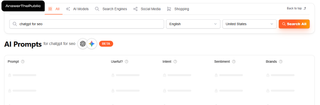
Pros: Great for AI prompts inspo, free.
Cons: Very limited as it only provides 30 prompt suggestions on free plans.
AI prompt research with SEMrush
Another well-known SEO tool that has added a free prompt research feature is SEMrush. Although this tool has no free plan, this AI prompt research tool works in a similar way to AnswerThePublic's AI Prompts feature, providing prompt ideas and commonly asked AI-related questions that users can use as inspiration for article headings and content ideas.
This feature, available only on paid plans, provides marketers with a comprehensive list of prompts that users are searching for in AI models. Unlike AnswerThePublic, it goes beyond just listing prompts as you can see detailed information about the questions people ask AI, as well as analyze the demand and difficulty of each topic, similar to traditional keyword research.

Pros: Provides great insights about the prompts like monthly volume or topic difficulty.
Cons: It's expensive.
Google's People Also Ask section
One of the tips that can help you get inspiration for real prompts users ask is to check the questions included in the "People Also Ask" section of Google. Even though it seems more focused on SEO, as they can be found in a search engine, these questions can potentially be prompts used by users in AI tools. We know that AI model teams have stated that search engines like Google are not used in any way, but users tend to make similar searches in Google and AI models, as both are actually question-answer tools.
To do so, you just need to search for anything related to the topic you want to cover on Google and look for the "People Also Ask" section. There, you will find a list of potential prompts that can be used to write or update your content.
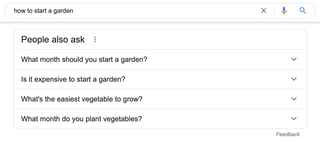
Pros: Free, great for getting inspo regarding headings and FAQ sections.
Cons: We don't actually know if they are real prompts people ask in AI tools.
Forums (Quora, Reddit, etc.)
Other great sources for prompt inspo are online forums. AI tools often base their results on content from platforms like Reddit or Quora, because these sources contain real user questions and answers which AI to consider more interesting and reliable than blog posts (and we all know why).
By exploring what people ask on these platforms, you can gain a better understanding of your audience and what they're looking for when searching for information about the topics you cover or the products you sell. On these forums, you'll find not only real questions that can directly serve as AI prompts, but also answers that can be referenced in your content to make it more credible and authoritative.
Pros: Real, user-generated questions, free.
Cons: Time-consuming.
Summary
Prompt research is becoming essential for marketers who want to appear in AI-generated responses. By following a structured approach—defining your goals, researching prompts with dedicated tools, and consistently tracking your visibility—you can optimize your content for the AI-driven search landscape. Start with free tools like Answer the Public or Google's People Also Ask, and gradually refine your strategy based on what works for your specific audience and topics.